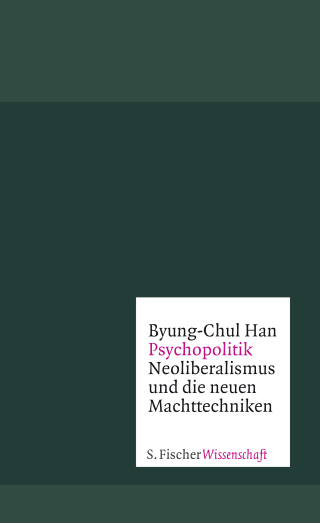
Psychopolitics

Following his bestseller Müdigkeitsgesellschaft, Berlin philosopher Byung-Chul Han continues his passionate criticism of neoliberalism. He shrewdly dissects the neoliberal regime’s techniques of governance and power – techniques which, unlike Foucault’s biopolitics, harness the human psyche as a productive force. Han’s description of psychopolitics’ many facets shows us a neoliberalism that leads to a crisis of freedom.
In the course of this analysis of neoliberal techniques of power, Han also presents a new theory of Big Data and a lucid phenomenology of emotion. But this brilliant new essay also develops countermodels to neoliberalism’s psychopolitics: rich in ideas and full of surprises.

Contact Foreign Rights
Rights sold to

MA (Mominoun without borders) PRC (Citic (simplified Chinese (world without Taiwan)) | DK (THP) | BR (Ayiné) | PT (Rélogio D'Água) | I (Nottetempo) | WEL (Verso) | F (Circé) | E (Herder (World)) | NL (Van Gennep) | KOR (Moonji) | TR (Metis) | EST (Postimehe) | HU (Typotex) | UA (Komubook) | VN (Phanbook)

  • Publisher: S. FISCHER
  • Release: 24.07.2014
  • ISBN: 978-3-10-002203-5
  • 128 Pages
  • Author: Byung-Chul Han
Psychopolitics
Byung-Chul Han Psychopolitics
S. Fischer Verlag GmbH
© S. Fischer Verlag GmbH
Byung-Chul Han

Byung-Chul Han, born in 1959, studied metallurgy in Korea, then philosophy, German, and Catholic theology in Freiburg and Munich. After a philosophy professorship in Basel, he became professor of philosophy and media theory at the Hochschule für Gestaltung in Karlsruhe in 2010. Since 2012, he has been a professor of cultural sciences at the Universität der Künste in Berlin. His books with S. Fischer include Psychopolitik: Neoliberalismus und die neuen Machttechniken (2014) and Die Errettung des Schönen (2015).